


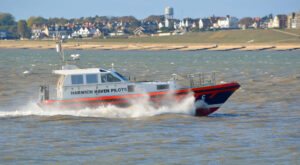
Harwich Haven Pilot Boat returning to port
Making safe, confident decisions at sea starts with having the right information at the right time. For the teams working at Harwich Haven Authority, a new wave monitoring solution is transforming how pilots, launch crews and Vessel Traffic Service (VTS) operators plan and manage pilot boarding operations.
Working in partnership with Harwich Haven Authority, we recently supported the deployment of a Datawell Wave Buoy, supplied by RS Aqua, at the pilot boarding area. The buoy now delivers live, high‑precision wave data directly into Port‑Log, our cloud‑based data platform—putting accurate, local information into the hands of the people who rely on it most.
For pilots and launch crews operating at the very edge of safe working conditions, understanding the true sea state at the boarding location is critical. Previously, teams often relied on data from nearby monitoring stations, which didn’t always reflect the real conditions at the pilot station itself. This added complexity to decision‑making and increased uncertainty during challenging conditions.
This project focused on giving people greater confidence in their day‑to‑day decisions. By listening closely to Harwich Haven Authority’s operational teams and understanding how decisions are made on the water, we helped deliver a solution that directly supports those working in demanding, time‑critical roles.
From the outset, we worked closely with Harwich Haven Authority to understand their operational challenges and guide them through the available monitoring options. Together, we selected the Datawell Wave Buoy for its accuracy, resilience and suitability for critical marine operations. Our engineers tested, configured and supported the deployment end‑to‑end, ensuring the system was ready to deliver from day one.
Now fully operational, the wave data is used daily by VTS teams, hydrographers and pilots, displayed alongside weather, tidal and AIS information within Port‑Log. For those on watch, this means faster access to trusted data and clearer situational awareness when planning pilot transfers.
Beyond immediate operational benefits, the data is also helping to build a longer‑term understanding of local conditions. By validating wave forecasts against real observations at the pilot station, Harwich Haven Authority can improve future predictions and planning. The data will also feed into an AI‑enabled digital twin, allowing teams to analyse historic and real‑time conditions together and better anticipate when pilot boarding may become unsafe.
William Barker, Marine Director & Harbour Master at Harwich Haven Authority, said:
“Accurate wave data at our pilot boarding areas has delivered an immediate operational benefit. When used alongside the experience of our pilot launch coxswains and VTS teams, and supported by weather and wave forecasts, it enables more informed, real‑time decisions based on actual conditions.”
The wave data will also soon be made available via Harwich Haven Authority’s public website (www.hha.co.uk), supporting greater transparency and shared understanding across the wider port community.
This project is a clear example of how combining trusted partnerships, proven technology and a people‑first approach, delivered through Port‑Log, can enable safer, smarter marine operations.
Back to News